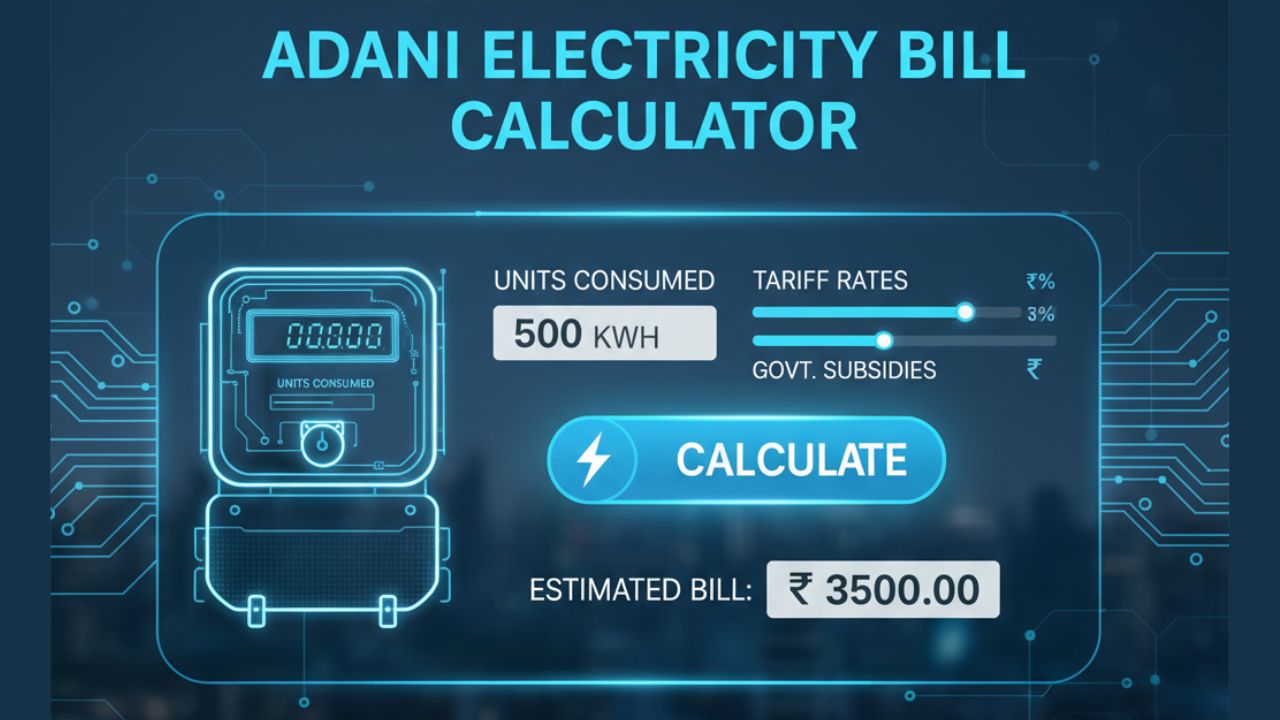
Adani Electricity Bill Calculator 2026-27
Frequently Asked Questions (AEML)
1. What are the latest Adani Electricity tariff slabs for Mumbai in 2026-27?
Under the latest MERC Multi-Year Tariff (MYT) order for FY 2026-27, Adani residential rates are: ₹2.65/unit (0-100 units), ₹5.85/unit (101-300 units), ₹7.10/unit (301-500 units), and ₹8.35/unit (above 500 units). Additional fixed charges, wheeling charges, and duty apply.
2. How is Rooftop Solar Net Metering calculated by Adani?
With an active net meter, the solar energy you generate is deducted from the electricity you import from the Adani grid. You are only billed for the ‘Net Units’. If you generate more than you use, the surplus is banked to offset future bills within the financial year.
3. What is the Wheeling Charge on my bill?
Wheeling charges are the fees paid for using the distribution network to transport electricity to your home. For the FY 2026-27 period, the residential wheeling charge for AEML is approximately ₹1.82 per unit.
4. How much is the State Electricity Duty in Maharashtra?
The Maharashtra State Government levies a mandatory Electricity Duty which currently stands at 16% for residential and standard commercial connections. It is calculated on the sum of energy charges, fixed charges, and wheeling charges.
5. Who qualifies for the BPL (Lifeline) category?
The Below Poverty Line (BPL) tariff applies to residential consumers with a sanctioned load up to 0.25 kW whose annual consumption was strictly under 360 units (approx. 30 units per month). They benefit from nominal fixed charges (₹12) and highly subsidized energy rates.
6. Why does my Fixed Charge increase when I use more power?
AEML’s fixed charges are tiered based on consumption. For instance, a residential connection consuming under 100 units might have a ₹90 fixed charge, which increases to ₹135 or ₹160 if the household consumes over 300 or 500 units, reflecting the higher infrastructure capacity required to serve you.
7. Does Adani have a separate rate for Commercial (LT-II) properties?
Yes, LT-II non-residential/commercial rates are higher. They generally feature a flat energy rate (around ₹6.55/unit) and a much higher fixed demand charge (e.g., ₹475 per month up to 20kW), catering to businesses, offices, and shops.
8. What is FAC (Fuel Adjustment Charge)?
FAC or FPPCA (Fuel and Power Purchase Cost Adjustment) is a variable charge applied to offset the fluctuating costs of coal and fuel used to generate electricity. It changes periodically as approved by MERC and is added per unit of consumption.
9. Is there a discount for paying my AEML bill digitally?
Yes, Adani Electricity offers a prompt payment discount and a small digital payment discount (often around 0.25% of the bill) for consumers who pay their bills before the due date via digital channels like UPI, Net Banking, or the official AEML app.
10. How do I pay my Adani Electricity bill online safely?
Always use the official portal (www.adanielectricity.com), the Adani Electricity mobile app, or verified third-party UPI apps (Google Pay, PhonePe, Paytm). Ensure you verify your 9-digit Account Number (CA Number) before making any payment.
Adani Electricity Bill Calculator 2026-27: Accurate Tariff Estimates for Mumbai Consumers
Navigating your monthly utility expenses in a bustling metropolis like Mumbai requires precision and awareness. With the Maharashtra Electricity Regulatory Commission (MERC) approving the Multi-Year Tariff (MYT) structure for the 2025-26 to 2029-30 control period, the rates for Adani Electricity Mumbai Limited (AEML) have been officially updated. The new 2026-27 tariff introduces subtle adjustments to both energy charges and fixed monthly costs, designed to balance infrastructure upgrades with consumer affordability. Because the billing formula involves complex variables—including progressive slabs, wheeling charges, and statutory duties—manually calculating your bill can be daunting. Our custom-built **Adani Electricity Bill Calculator 2026-27** simplifies this process entirely. By factoring in the exact MERC-approved rates, this responsive digital tool allows residential and commercial users across the Mumbai suburbs to accurately forecast their monthly electrical overheads.
Understanding the Tiered Slab Structure (LT-I Residential)
Adani Electricity operates on a telescopic, tiered slab billing system for its residential (LT-I) consumers. This system is designed to promote energy conservation: the less you use, the cheaper the per-unit rate. For the 2026-27 financial year, the base energy charge for the first 100 units is kept highly subsidized at just ₹2.65 per unit. However, as your consumption climbs, so do the costs. The subsequent 101 to 300 units are billed at ₹5.85, the 301 to 500 units hit ₹7.10, and any consumption exceeding 500 units faces the premium rate of ₹8.35 per unit. Furthermore, AEML’s fixed charges dynamically adjust based on your consumption bracket. A low-consumption household pays a ₹90 fixed charge, while a household drawing over 500 units will see that fixed cost rise to ₹160. By selecting the ‘Residential’ option in our calculator, the internal algorithm instantly processes these intersecting variables, displaying a transparent, line-by-line breakdown of how your units are distributed across these slabs.
The Power of Rooftop Solar Net Metering in Mumbai
As sustainability becomes a primary focus for urban homeowners and housing societies, Rooftop Solar Net Metering has emerged as a game-changer. Adani Electricity actively supports grid-connected solar installations. Under the net metering framework, your solar panels generate direct current (DC), which is converted to alternating current (AC) and fed into your home. Any excess power you don’t immediately use flows back into the AEML grid. At the end of the billing cycle, you are billed only for the “Net Units” (Total Imported Units minus Total Exported Solar Units). Our calculator includes a dedicated Solar Net Metering field to reflect this reality. If you generate 200 units of solar power and consume 350 units from the grid, the calculator will apply the tariff slabs exclusively to the remaining 150 net units. This feature visibly demonstrates the massive ROI of installing solar, often pushing high-consumption households out of the expensive premium slabs and back into the affordable base tiers.
Commercial and BPL Consumer Categories
Beyond standard residential setups, Mumbai’s economic landscape consists of vibrant commercial spaces and essential lifelines for the economically disadvantaged. The calculator explicitly addresses these demographics. For commercial entities (LT-II), the electricity tariff dispenses with the forgiving lower slabs. Instead, businesses face a steeper flat-rate energy charge and a significantly higher fixed demand charge, which is calculated based on their sanctioned kW load. On the opposite end of the spectrum, the Below Poverty Line (BPL) category serves as a protective safety net. Applicable exclusively to households consuming under 30 units a month with minimal connected load, the BPL tariff charges just ₹1.52 per unit with a negligible ₹12 fixed charge. By selecting your exact category, the calculator bypasses generalized averages and applies the exact MERC mandate relevant to your connection type.
Decoding Wheeling Charges, Duty, and Additional Fees
An electricity bill in Maharashtra is never just the sum of the energy consumed; it includes vital network and statutory charges. The ‘Wheeling Charge’ is a prime example. This is the toll paid for maintaining and utilizing the local distribution wires and transformers. For AEML in 2026-27, the residential wheeling charge averages ₹1.82 for every unit consumed. Additionally, the Maharashtra Government levies a mandatory 16% Electricity Duty, applied not just to your energy consumption, but to your fixed and wheeling charges combined. Our tool seamlessly calculates these hidden variables, ensuring the final “Estimated Total Bill” mirrors the actual document you will receive from Adani Electricity. While Fuel Adjustment Charges (FAC) can vary slightly month-to-month based on wholesale coal prices, this calculator provides a highly accurate baseline framework.
Actionable Strategies to Lower Your Adani Electricity Bill
Utilizing this calculator is your first step toward effective energy management. To translate these estimates into real savings, start by optimizing your home appliances. Since Mumbai experiences high humidity year-round, air conditioners are the primary culprits for bloated bills. Upgrading to 5-Star Inverter ACs and setting the thermostat strictly between 24°C and 26°C can prevent you from crossing into the punitive ₹8.35 premium slab. Secondly, ensure your “Connected Load” accurately reflects your needs; paying for a 10 kW sanctioned load when you only require 3 kW means you are bleeding money on unnecessarily high fixed charges. Always take advantage of digital payment discounts by settling your dues promptly via the Adani app or UPI. Finally, keeping an eye on your smart meter readings and running periodic checks on our Adani Electricity Bill Calculator 2026-27 will empower you to adjust your consumption habits dynamically, ensuring your household remains financially and energetically efficient throughout the year.