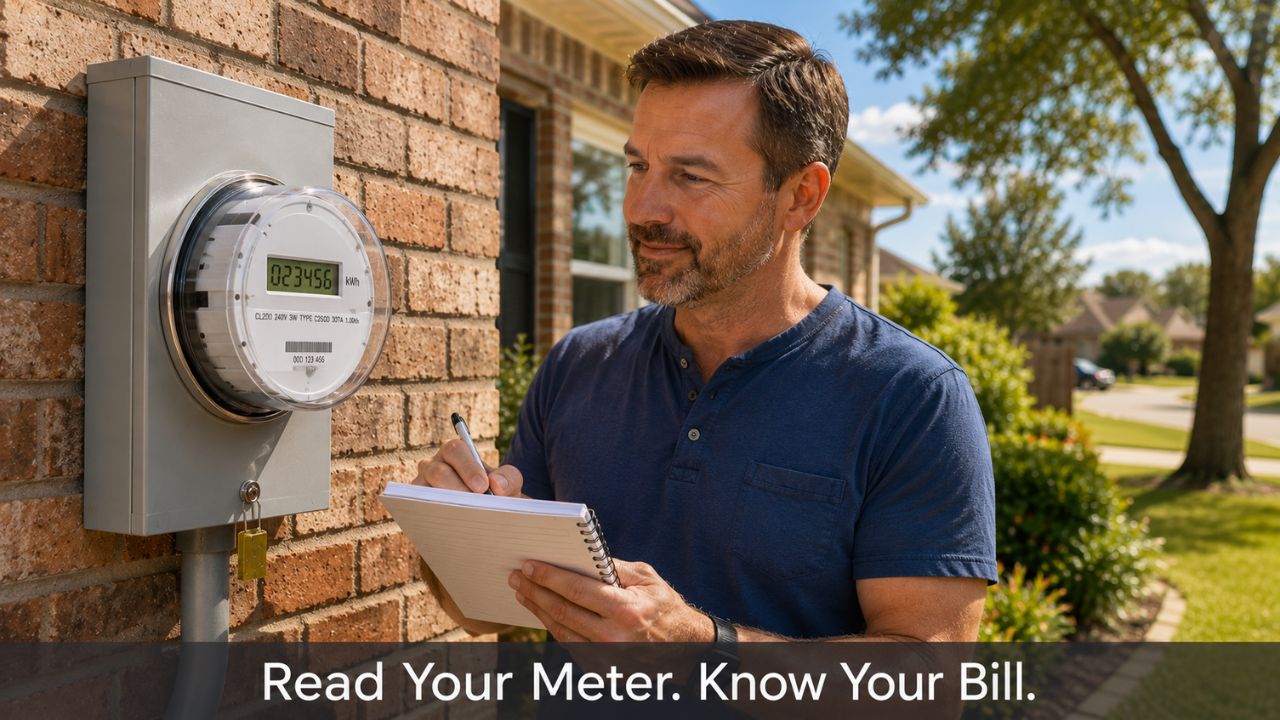
Have you ever wanted to know how much electricity you have used before your bill shows up in the mail or app? Reading your meter and doing the simple math yourself gives you that answer.
In Texas, most homes now have digital or smart meters, but some older properties still use analog dial meters. Either way, the process is straightforward once you know what to look for.
This guide walks you through reading your meter correctly, calculating your exact kilowatt-hour usage, and then turning that number into your full estimated electric bill, including energy charges, TDU delivery fees, and taxes.
Why Read Your Meter Yourself in Texas
Your electric bill is based on the difference between two meter readings taken about 30 days apart. The utility or your REP uses those readings to calculate how many kilowatt-hours (kWh) you used.
Reading the meter yourself helps in several practical situations. You can check mid-cycle usage to see if you are on track for a high bill. You can verify the kWh number that appears on your statement. And you can estimate what your next bill might look like before it arrives.
In Texas’s deregulated market, the kWh you use drives both the energy charge from your Retail Electric Provider and most of the TDU delivery charges from your local utility. Getting the usage number right is the foundation of an accurate bill.
How to Find and Read Your Texas Electric Meter
Your meter is almost always located outside your home. Walk around the side or back of the house. Look for a gray or black box mounted on the wall, often near the air conditioner or electrical panel. It may be in a small locked enclosure.
Digital and Smart Meters (Most Common in Texas)
Modern meters have a clear digital display that shows the total kilowatt-hours used.
- Look for the number labeled “kWh,” “Total,” or “Delivered.”
- Write down the full number, including any digits after a decimal point if shown.
- Ignore any flashing lights or smaller test numbers unless you are checking instantaneous usage.
- Many smart meters also let you view recent daily or hourly data through your utility’s app or website.
Analog Dial Meters (Older Homes)
These have four or five round dials that look like clock faces.
- Read the dials from left to right.
- For each dial, record the number the pointer has just passed. If the pointer sits between two numbers, use the lower number.
- If a pointer lands exactly on a number, check the dial to its right. If that dial has passed zero, use the number shown. If not, use the lower number.
- Write the numbers in order to get your current reading.
Comparison: Digital vs Analog Meter Reading
| Feature | Digital/Smart Meter | Analog Dial Meter |
|---|---|---|
| Ease of reading | Very easy, just copy the number shown | Requires careful dial-by-dial reading |
| Accuracy | High, includes decimals | Good when read correctly, easy to misread |
| Extra data available | Often shows daily or hourly usage via app | Only cumulative total visible |
| Common in Texas 2026 | Yes, in most deregulated areas | Less common, mostly older homes |
| Best for quick checks | Excellent | Still workable with practice |
Calculate kWh Usage from Your Meter Readings
Once you have two readings, the math is simple.
- Write down the current meter reading.
- Find your previous reading (from your last bill or the note you took last month).
- Subtract the previous reading from the current reading.
Example: Current = 45,872 kWh. Previous = 44,672 kWh.
45,872 − 44,672 = 1,200 kWh used this period.
That 1,200 kWh is the number your provider will use to calculate most charges on your bill.
Pro Tip: Take your reading at roughly the same time of day each month. This keeps your billing period consistent and makes comparisons easier.
How to Turn Your kWh Usage into Your Full Electric Bill
Now that you have your usage, you can estimate the entire bill. You will need three more pieces of information:
- Your current energy rate from your REP (found on the Electricity Facts Label or bill).
- Your TDU’s fixed monthly charge and per-kWh delivery rate (shown on your bill or available on your utility’s website).
- Your local sales tax rate.
Here is the basic formula:
Total Estimated Bill = (kWh × Energy Rate) + TDU Fixed Charge + (kWh × TDU per-kWh Rate) + Regulatory Fees + Sales Tax
Real Example Using 1,200 kWh
Assume you used 1,200 kWh this month, your energy rate is 9.0¢ per kWh, your TDU charges a $5 monthly customer fee plus 5.5¢ per kWh, the PUC assessment is $0.65, and sales tax is 8.25%.
| Line Item | Calculation | Amount |
|---|---|---|
| Energy Charge | 1,200 kWh × 9.0¢ | $108.00 |
| TDU Customer Charge | Fixed monthly | $5.00 |
| TDU Delivery Charge | 1,200 kWh × 5.5¢ | $66.00 |
| PUC Assessment | Flat fee | $0.65 |
| Subtotal before tax | — | $179.65 |
| Sales Tax (8.25%) | 8.25% of $179.65 | $14.82 |
| Estimated Total Bill | — | $194.47 |
Your actual bill may vary slightly depending on exact rates, any bill credits, or riders in effect that month. This method gets you very close.
Common Mistake: Reading the meter on a different day than your normal billing cycle and then comparing it directly to your bill. If your bill covers June 5 to July 5 but you read on July 10, you have extra days of usage that will not match. Always note the exact date of your reading and compare only similar periods.
Another frequent error is misreading analog dials by going right to left or forgetting that some dials turn counterclockwise. When in doubt, take a clear photo of the meter and double-check later.
Practical Tips for Better Accuracy and Lower Bills
- Read your meter at the same time of day each month for consistent comparisons.
- Use your utility’s app or website if you have a smart meter. Many show daily usage graphs that make spotting problems easy.
- Keep a simple notebook or phone note with date and reading. After a few months you will see clear patterns.
- High usage in Texas almost always comes from air conditioning. Check your thermostat settings and filter condition first.
- If your estimated bill is much higher than expected, re-check the subtraction and confirm you used the correct rates from your current EFL.
Numbered List: Quick Mid-Month Bill Estimate
- Read your meter today and subtract the reading from your last bill.
- Multiply that partial kWh by your energy rate.
- Add roughly half your normal TDU fixed charge.
- Add the partial TDU per-kWh charge.
- Add estimated tax.
This gives you a good ballpark for what to expect at month-end.
What If You Have Solar or Special Rates?
If you have rooftop solar, your meter may show two numbers: energy delivered to you and energy sent back to the grid. Net metering or buyback rules vary by provider. In that case, your bill calculation uses the net kWh (energy in minus energy out). Check your specific plan’s EFL or call your REP for exact rules.
Time-of-use plans charge different rates at different hours. A simple meter reading gives total kWh but not when you used it. For those plans, you may need hourly data from your smart meter or utility portal to calculate accurately.
FAQs About How to Calculate Texas Electric Bill from Meter Readings
How often should I read my meter if I want accurate estimates?
Reading once a month on roughly the same date as your billing cycle works well for most people. If you are trying to catch high usage early, read every two weeks during summer when air conditioning use can spike quickly.
What if my meter is a smart meter? Do I still need to read it?
Smart meters are read automatically by your utility, but you can still view the current total on the display or through your provider’s app or website. Reading it yourself is useful for mid-cycle checks or if you want to verify the number that appears on your bill.
Can I calculate my exact final bill just from the meter reading?
You can get very close. The exact bill also depends on your specific REP rate plan, any bill credits, riders, and the precise TDU rates in effect. Using the steps above with the rates from your Electricity Facts Label will give you an estimate within a few dollars of the final amount in most cases.
Conclusion
Reading your meter and calculating usage yourself puts you in control. You no longer have to wait for the electricity bill to know where you stand. The process takes just a couple of minutes once you get comfortable with it.
Next time your bill arrives, compare the kWh they used against your own reading. You will quickly see whether everything lines up. If your usage or costs keep climbing, a quick review of your plan or daily habits can often bring them back down. Start with one reading this week. You will be surprised how useful the habit becomes.
Disclaimer: This content is for informational and educational purposes only and does not constitute professional, financial, legal, or medical advice. The information provided may not apply to your specific situation. Always consult a qualified professional for personalized guidance.