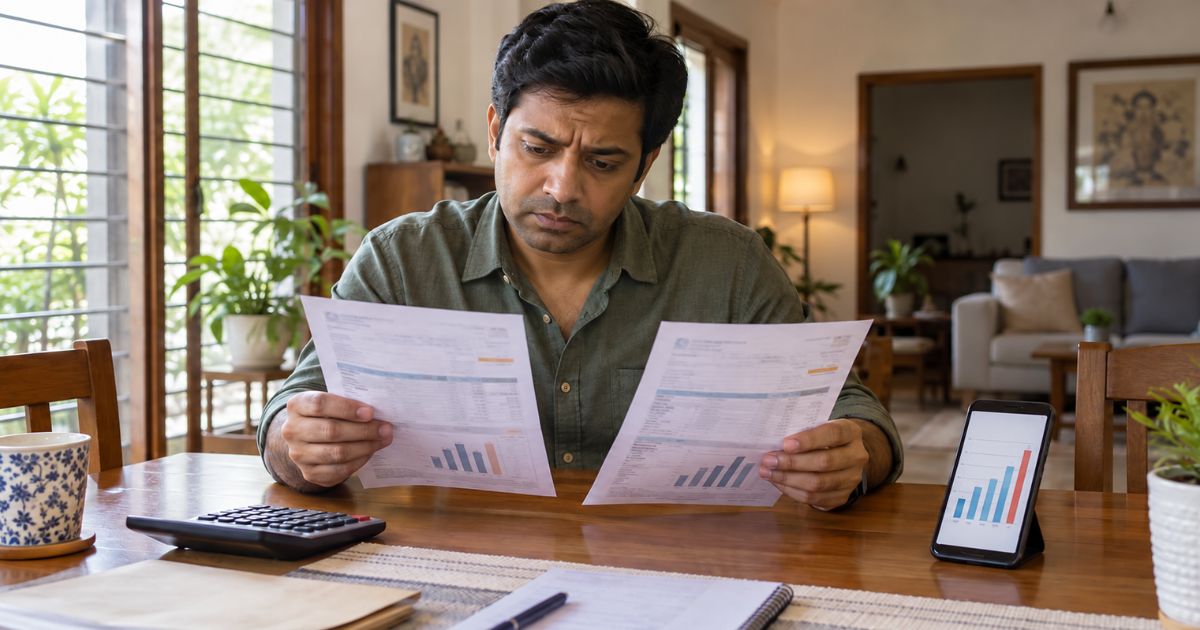
If your electricity bill is suddenly high even though your routine has not changed, compare the number of units billed, the number of billing days, and the individual charges before assuming that your meter is defective. An estimated-reading correction, tariff revision, expired subsidy, fixed charge, or old balance may explain the increase.
The goal is to find out whether your home used more electricity or whether the price and account adjustments changed. This step-by-step guide is for Indian consumers with conventional, digital, or smart electricity meters.
Electricity Bill Suddenly High: 11 Things to Check
Most electricity statements contain several amounts, not just a simple number of units multiplied by one rate. Consumption slabs, fixed charges, electricity duty, approved adjustments, and previous dues can affect the final payable amount. The exact structure is set by the relevant state tariff and electricity provider.
Download two or three consecutive bills before investigating. Keep the dates, units, meter readings, consumer category, and line-item charges visible. The most useful clue is often whether the units changed, the price per billed unit changed, or an additional amount appeared.
1. Count the actual billing days
A longer billing period can create a larger bill without a change in average daily electricity use. A 40-day bill will usually include more units than a 30-day bill under similar conditions. Look at the dates printed on the statements instead of comparing totals alone.
Divide billed units by the number of days in each period. Suppose a home used 180 units over 30 days, or 6 units per day. If it later used 240 units over 40 days, the daily average remains 6 units. The total rose because the billing window was longer, not necessarily because the home became less efficient.
2. Check if the reading was actual or estimated
If a provider could not obtain a reading earlier, it may issue an estimated bill and adjust the account once an actual reading is available. The next invoice can look unusually high because it captures consumption not reflected in the earlier estimate. This is sometimes called a billing adjustment or reconciliation.
Find the previous and current meter readings, reading type, and any adjustment note. Ask the DISCOM for the calculation if the reconciliation is not clear. An earlier low bill can make a corrected bill look extreme even when the combined units across both periods are reasonable.
3. Look for a tariff or slab change
Residential electricity rates in India vary by state, DISCOM, connection type, and sanctioned load. Many tariffs use consumption slabs, which can cause the average billed rate to change as usage crosses a threshold. Tariff orders and applicable adjustment mechanisms may also change over time.
Check the latest official tariff schedule from your DISCOM or state electricity regulatory commission. Do not use an online rate quoted for a different state or year as proof of overbilling. The same 250 units may cost different amounts in two locations because their tariff structures differ.
4. Check whether a subsidy or rebate changed
A government subsidy, rebate, or category-based concession can reduce a bill. If eligibility, consumption threshold, documentation, or accounting changes, the benefit shown on a statement may be smaller or absent. This can raise the payable amount even when the units are similar.
Compare the subsidy line with earlier bills and read the current state government’s or DISCOM’s official scheme instructions. Do not assume that a subsidy offered in one state applies in another. Ask the provider whether any missing credit can be corrected and what documents are required.
5. Separate fixed charges from energy charges
Some tariffs impose a fixed, service, or demand-related charge linked to the connection or sanctioned load. This can be payable even when electricity consumption is low. If a billing period covers more days or a connection detail changes, the fixed portion may differ from what you usually see.
Look for fixed charge, minimum charge, demand charge, and load-related entries. Compare them with the current tariff for your consumer category. Reducing appliance consumption is useful, but it does not necessarily remove a valid fixed charge.
6. Look for arrears, penalties, and adjustments
Old unpaid balances, late-payment surcharges, corrected payment entries, and other permitted adjustments can make a bill larger than its current energy use suggests. These should not be treated as new units. They are account-level items that need to be checked separately.
Review the payment history, including receipts for recent transactions. If the bill still includes an amount already paid, request a ledger reconciliation and provide the payment reference. If a charge is unfamiliar, ask what tariff or account rule authorizes it.
7. Check fuel and electricity-duty lines
Depending on the state and tariff, a bill may show electricity duty, fuel-related adjustments, or other approved components. Their names and calculation methods differ, so a generic percentage should not be applied nationwide. Also distinguish electricity charges from separately taxable services.
Compare each line with the previous invoice and any current official notices. If a surcharge rises significantly, request the effective dates and calculation basis. A transparent answer should identify the charge separately from your consumed kWh.
8. Account for seasonal appliance use
People often underestimate how much weather changes normal appliance behavior. An AC can run longer during a heat wave, while heaters and geysers may run more in cooler months. Refrigerators and water pumps can also cycle more often under certain conditions.
Review operating hours, not just whether the appliances are present. You can estimate energy using kilowatts × hours used = kWh. For example, a device averaging 1 kW for an extra 2 hours a day over 30 days adds 60 kWh, or 60 units. This is an illustrative calculation, not a fixed estimate for any particular AC.
9. Check for a faulty appliance or wiring issue
A failing pump, continuously running water heater, damaged thermostat, or incorrect appliance setting can increase consumption without an obvious lifestyle change. Look for unusual running times and compare the daily unit trend. If a device is unusually hot, noisy, or unsafe, turn it off using the normal controls where safe and seek qualified help.
Do not open the electric meter, bypass safety devices, or touch live wiring. A licensed electrician can inspect the household circuit and equipment. Meter testing is a separate utility procedure and should be arranged through the DISCOM.
10. Check meter replacement and consumer details
If the provider recently installed a new meter, verify that the old meter’s final reading and the new meter’s first reading were recorded correctly. Check meter numbers and any transfer or replacement document. A mismatch could create an incorrect reading reconciliation.
Also review the billing account’s consumer category and sanctioned load. If they are wrong, submit evidence and ask for a written correction. A domestic connection billed under an inappropriate category may need a tariff review even if the unit count is accurate.
11. Compare the bill with an independent estimate
Calculate the units from two matching cumulative readings where appropriate, then compare those units with the bill. Use the site’s electricity bill calculator for a rough estimate, remembering that tariff slabs, duties, subsidies, and other charges can create differences.
A quick example: same usage, higher payment
Imagine two 30-day bills showing exactly 200 units. The first has an illustrative energy charge of ₹1,100 and other charges totaling ₹100, so the payable amount is ₹1,200. The second has the same consumption and energy charge but also shows a separate ₹350 carried-forward balance, making the total ₹1,550.
That is a 29.2% increase in the amount due without any increase in units. The numbers are hypothetical and do not represent an actual DISCOM tariff. The lesson is to compare the breakdown, not just the amount printed in large type at the top of the bill.
What to do if the difference remains unexplained
- Download the disputed bill, the previous two bills, and payment receipts.
- Record billing dates, reading type, units, meter number, and tariff category.
- Circle every new or changed line item and note its amount.
- Contact the utility using the official website, app, office, or helpline.
- Request a line-item explanation and meter check if consumption data appears inconsistent.
- Keep the complaint reference and escalate through the prescribed grievance mechanism if needed.
India’s Electricity (Rights of Consumers) framework and 2024 amendments address consumer complaints and consumption verification. Follow your state’s applicable procedures and ask whether any undisputed amount should still be paid while the complaint is investigated.
How to prevent another unexplained jump
Keep monthly records of billed units, average units per day, payment amounts, and subsidy or adjustment lines. If you have a smart meter, review daily usage trends when available. For other meters, save a dated photograph of the relevant energy register every few weeks.
Focus on repeatable comparisons. A single expensive month is not enough to conclude that the meter is wrong, but a clear record of stable units with an unexplained charge gives the DISCOM something specific to investigate.
FAQs About a Suddenly High Electricity Bill
Q. Can the bill increase even if the number of units stays the same?
A. Yes. Tariff components, subsidies, fixed charges, arrears, and adjustments can change the amount due without changing current-period units.
Q. Does a high bill mean the meter is defective?
A. No. Review billing days, readings, charges, and appliance usage first. Request formal testing if a meter issue remains plausible.
Q. Will complaining automatically stop disconnection?
A. Do not assume so. Ask your DISCOM about the disputed-bill process, any payment requirements, and applicable consumer protections.
Q. Should I compare bills from the same season?
A. Yes, whenever possible. Cooling and heating demand can differ greatly across seasons, making a same-season comparison more meaningful.
Conclusion
When an electricity bill is suddenly high, check usage, dates, readings, rates, subsidies, and separate account charges before blaming the meter. Keep records and ask your DISCOM for a written explanation of any difference you cannot reconcile.
Disclaimer
This article is general educational information about electricity billing in India. Tariffs, subsidies, meter procedures, and complaint rules vary by state and provider. Official DISCOM and regulator information takes precedence.