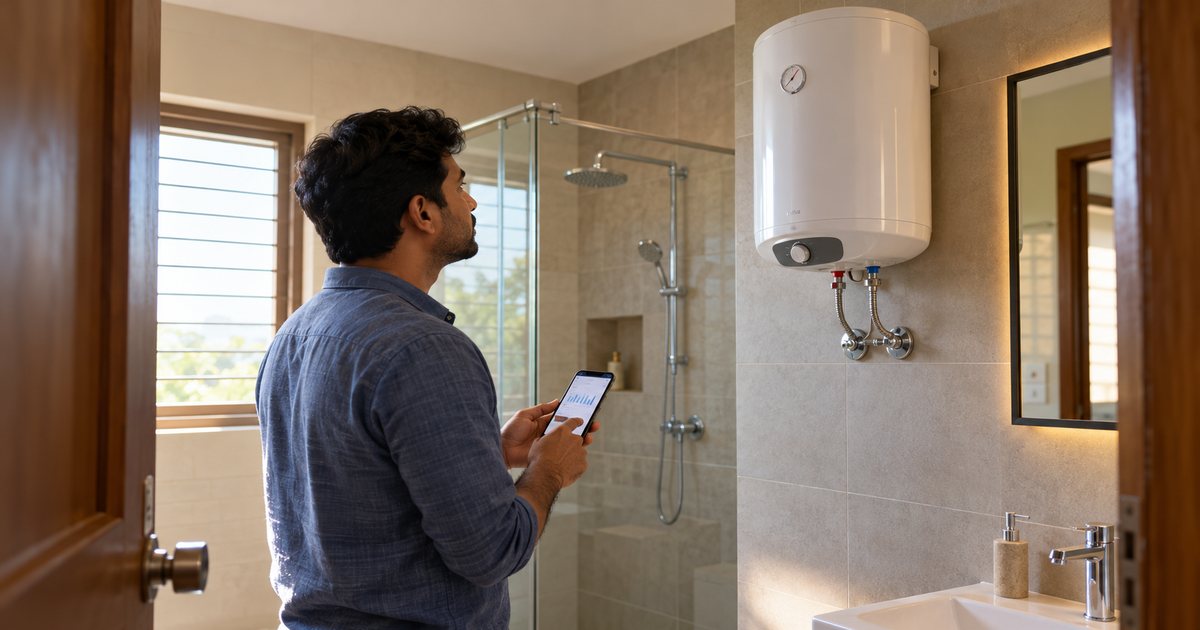
Geyser electricity consumption per month depends on how much hot water your household uses, the temperature increase needed, the heater’s insulation, and its total operating time. For example, an electric element drawing 2,000 watts for 30 minutes consumes 1 unit (kWh). If it runs for that amount of time daily over 30 days, the direct energy use is about 30 units.
A storage geyser can also consume electricity to replace heat lost while hot water sits in the tank. This guide shows a practical estimation method for Indian homes, explains BEE star labels, and outlines safe ways to avoid unnecessary energy use.
Geyser Electricity Consumption Per Month: Unit Formula
One unit of electricity equals one kilowatt-hour, or kWh. For any electric heating element, energy consumed is its electrical input multiplied by the total time it draws that power. A thermostat-controlled storage geyser normally cycles off when it reaches its target temperature, which makes the total heating time different from the hours it stays switched on at the wall.
A simple estimate uses monthly units = element watts ÷ 1,000 × heating hours per day × days. This works when you estimate the element’s actual energized time, not merely the number of hours the appliance remained connected.
1. Estimate units from the heating element
Suppose a water heater has a 2 kW heating element. If it actually draws power for 20 minutes a day, that is 2 × (20 ÷ 60) = approximately 0.67 units daily. Over 30 days, the estimated energy is 20 units, excluding any extra periods needed to maintain hot water.
At 40 minutes of daily element operation, the monthly total would be approximately 40 units. If a model has a different power rating, calculate using that actual value. Do not assume all storage geysers use exactly 2,000 watts.
2. How much energy is needed to heat water?
A rough physics calculation can estimate the energy needed to raise a known volume of water by a set number of degrees. For water, energy in kWh is approximately litres × temperature increase in °C × 0.001163, assuming one litre is roughly one kilogram and ignoring heat loss.
Heating 15 litres of water by 35°C therefore needs about 15 × 35 × 0.001163 = 0.61 kWh of heat. Electrical input will be somewhat higher once losses are considered. For a 25-litre tank with the same temperature rise, the ideal thermal energy is about 1.02 kWh.
3. Example monthly costs for 15L and 25L geysers
These hypothetical scenarios use full tank volumes, a 35°C rise, and 30 days of one heating cycle per day. They show the heat required for the water, not a guaranteed utility meter reading for a particular appliance.
| Water heated each day | Ideal energy/day | 30-day total |
|---|---|---|
| 15 litres | 0.61 kWh | 18.3 units |
| 25 litres | 1.02 kWh | 30.5 units |
| 40 litres | 1.63 kWh | 48.8 units |
Real household costs will reflect the actual quantity of water heated, thermostat setting, losses, and electricity tariff. At a hypothetical ₹8 per unit, 30.5 units of ideal heating energy would cost approximately ₹244 before additional tank losses and billing adjustments.
4. Why the geyser’s litre capacity is not its electricity rating
A 15L or 25L label describes how much water the tank stores. It does not directly tell you the amount of electrical power used per hour. Two storage geysers of different capacities may both have 2 kW heating elements but need different lengths of time to heat a full tank.
A bigger tank may consume more energy when heating a larger volume, yet a household that draws only a small amount of hot water may not reheat the full volume each time. Estimate actual hot-water demand instead of multiplying the storage capacity by the number of showers without context.
5. What is standing loss in a storage geyser?
Hot water gradually loses heat through the insulated tank and associated pipes. Standing loss is the energy needed to maintain the stored water’s temperature while little or no hot water is drawn, measured under defined test conditions. It matters when a heater stays energized for long periods.
The Bureau of Energy Efficiency’s appliance-efficiency guidelines explain standing-loss measurements for stationary storage-type electric water heaters. When comparing product labels, use the valid current label period rather than relying on historic star-band figures.
6. Does a five-star geyser use less power?
A five-star storage heater can offer better heat retention than lower-rated comparable products under the applicable BEE scheme. That can reduce the energy lost while hot water is stored. It does not mean its heating element must have a lower wattage or that heating a given amount of cold water requires no energy.
Check the exact model’s BEE label, its storage capacity, rated power, label period, and any stated standing-loss figure. A high-rated model may be especially useful where the tank stays heated for long hours, but the actual savings depend on how the household uses it.
7. Why leaving the switch on all day can increase consumption
A properly functioning thermostat may switch the heater off after reaching the selected temperature. But the unit can cycle on again to replace lost heat. As a result, leaving a hot tank ready continuously can use more electricity than heating water only when needed, depending on water demand and heat loss.
A timer or sensible use schedule may reduce unnecessary holding time. However, follow the manufacturer’s safety instructions and consider household needs, including hot-water availability, hygiene, and any recommended temperature practices. Do not bypass thermal protection devices to save power.
8. Cold weather and incoming water temperature
Water arriving in winter may be much colder than water supplied in summer. Reaching the same hot-water temperature therefore requires a larger temperature rise and more energy. This can explain why geyser use increases winter bills without a change in family size.
For example, heating 20 litres from 15°C to 55°C requires an ideal 0.93 kWh, while heating it from 30°C to 55°C needs about 0.58 kWh. These are physics-based approximations that ignore tank and pipe losses.
9. How family size affects geyser usage
More users and longer showers generally increase hot-water demand. Yet use is not directly proportional to the number of people because mixing hot and cold water, bathing habits, and simultaneous usage affect the amount the heater must replace.
A practical method is to estimate how many litres of hot water are drawn each day and how much the incoming water must be heated. Measure over a few normal days if possible. A nominal 25-litre storage tank does not mean every household consumes exactly 25 litres of freshly heated water per person.
10. Geyser size, insulation, and efficiency
Choosing the right tank depends on usage, available space, supply pressure, and installation requirements. Oversizing can increase standby loss or purchase cost, while undersizing may leave users without adequate hot water. Efficiency and safety should be considered alongside tank capacity.
Look at insulation performance and service support before buying. Some models use different thermostat controls and anti-corrosion designs. These features may affect comfort and longevity, but their impact on electricity consumption should be supported by credible test data.
11. How to estimate a geyser’s share of your electricity bill
- Check the heater’s electrical input rating in watts.
- Estimate the minutes or hours the heating element operates each day.
- Divide watts by 1,000 and multiply by the operating hours and days.
- Allow for additional reheating needed to offset storage and pipe losses.
- Apply your relevant DISCOM tariff to estimate the additional energy cost.
- Compare with whole-home kWh data over similar days to spot changes.
Our power consumption calculator can estimate energy from appliance wattage and hours. For tariff-based costs, consult the corresponding state or DISCOM calculator and your official bill.
12. Common mistakes in online geyser calculators
A common error is treating an appliance’s full power rating as continuous electricity use. A 2 kW geyser connected for 10 hours does not necessarily use 20 units, because its thermostat may stop heating for much of that time. Conversely, assuming just one short heating cycle while a tank loses heat all day can understate use.
Another mistake is comparing star ratings from different label periods without checking the testing standard. Temperature rise, tank volume, operating time, and standing loss should be identified separately when evaluating estimates.
13. Safe habits for reducing water-heating costs
Heat only the water you need while following the manufacturer’s instructions. Repair dripping hot-water taps and insulate exposed approved hot-water piping where appropriate. Have unusual cycling, leaks, or thermostat problems inspected by a trained technician.
Do not open electrical terminals, disable earthing, bypass the thermostat, or alter safety valves. Geysers operate near water, which makes electrical safety particularly important. Use an authorized installer for replacement or repairs.
14. When higher electricity use may signal a problem
If the heater begins running far more often, produces less hot water, trips protective devices, or leaks, stop using it where safe and request qualified service. Poor insulation, scale buildup, a faulty control, or plumbing leaks can affect efficiency and performance.
Do not assume the electric meter is wrong before checking other appliances and billing adjustments. Compare the current statement with earlier bills of similar length and read any arrears or fixed-charge lines separately.
FAQs About Geyser Electricity Consumption
Q. How many units does a 2,000-watt geyser use in one hour?
A. If its element draws 2,000 watts continuously for a full hour, it uses 2 kWh, or 2 units.
Q. Does a 25L geyser always consume more than a 15L model?
A. Not necessarily in every household. Actual use depends on how much water is heated, the temperature rise, and tank heat losses.
Q. Does a five-star water heater heat water without using much electricity?
A. No. Heating water still requires energy. A stronger star rating generally indicates better performance under the applicable storage-loss test.
Q. Can leaving the thermostat on increase units?
A. Yes. The heater may reheat stored water to replace heat lost over time, depending on its controls and insulation.
Conclusion
Geyser electricity consumption per month can be estimated from actual element operating time and hot-water demand, with an allowance for tank heat loss. Compare your appliance rating and BEE label before making changes.
Disclaimer
Examples are educational estimates, not model-specific energy tests or official electricity tariffs. Use current BEE information, manufacturer instructions, and qualified professionals for electrical safety.