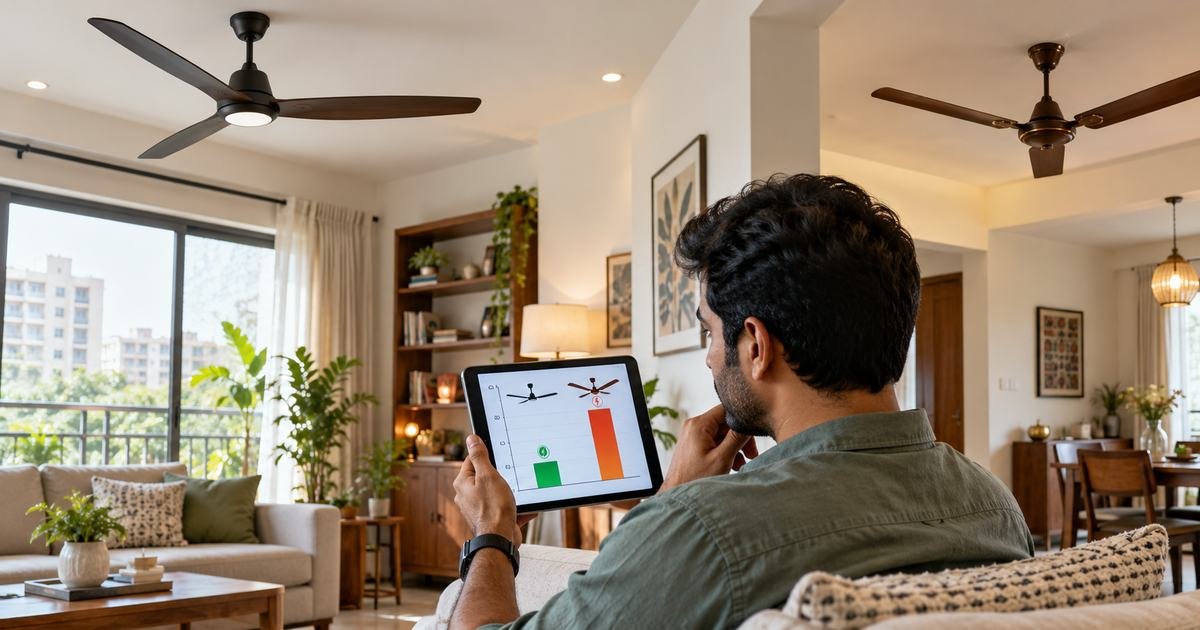
In a BLDC fan vs normal fan comparison, the BLDC model often uses less electricity for comparable airflow. For example, an older ceiling fan drawing 75 watts uses 27 units over 30 days when run for 12 hours daily. A 30-watt BLDC fan under the same schedule uses 10.8 units, saving 16.2 units for that month.
Those wattages are illustrative, not measurements of every product. The right comparison uses each fan’s actual rated power, airflow, daily hours, and electricity rate. This guide explains energy savings, running costs, buying considerations, and how to estimate payback in India.
BLDC Fan vs Normal Fan: Power and Running Costs
BLDC stands for brushless direct current. In a typical BLDC ceiling fan, electronic controls drive an efficient motor, even though the fan connects to ordinary household AC electricity. Conventional ceiling fans commonly use an induction motor. The motor design and controls can affect power draw, efficiency, features, and purchase price.
However, BLDC is not automatically a synonym for maximum efficiency or good airflow. A newer efficient induction fan may use much less power than an old non-rated fan, and two BLDC models can differ in their performance. Compare verified product specifications, not just the motor label.
How to calculate ceiling-fan electricity consumption
One electricity unit is one kilowatt-hour. The basic formula is units = fan watts ÷ 1,000 × hours per day × number of days. Multiply units by an assumed electricity rate to estimate the energy cost for that period.
If a 75-watt fan runs 12 hours a day for 30 days, the calculation is 75 ÷ 1,000 × 12 × 30 = 27 kWh. A 30-watt fan used identically consumes 10.8 kWh. Subtract the two figures to get 16.2 units of potential energy savings.
Monthly electricity use at different wattages
Here are example figures for 12 operating hours each day over a 30-day month. The table illustrates the arithmetic and should not be treated as a certified list of product specifications.
| Fan wattage | Monthly units | Energy cost at ₹8/unit |
|---|---|---|
| 75 W | 27.0 kWh | ₹216.00 |
| 60 W | 21.6 kWh | ₹172.80 |
| 45 W | 16.2 kWh | ₹129.60 |
| 30 W | 10.8 kWh | ₹86.40 |
All figures assume constant rated input and an illustrative per-unit energy rate, not a real statewide tariff. Actual power varies by model, control setting, and testing conditions. Fixed charges, subsidies, slabs, and electricity duty are excluded from this simple appliance comparison.
How much could you save in a year?
Using the 75-watt versus 30-watt example, the difference is 45 watts, or 0.045 kW. If both run 12 hours per day for 365 days, the annual saving is 0.045 × 12 × 365 = 197.1 kWh. At the example rate of ₹8 per unit, that equals ₹1,576.80 a year.
If the fans operate only during part of the year, the savings will be lower. If they run longer each day, the savings will generally be higher. Real annual savings also depend on the electricity rate applying to the units you avoid, not necessarily the headline average bill rate.
What does the BEE label tell you?
India’s Bureau of Energy Efficiency (BEE) uses an appliance Standards and Labelling programme to help consumers compare energy performance. Ceiling fans are among the product categories covered by the programme.
Look at the star label for the exact model, its validity period, input power, and related performance measures. Because standards and rating thresholds can change, comparing old and new labels without checking their periods may be misleading. Consult BEE’s appliance information for the currently applicable scheme.
Air delivery matters as much as watts
A fan is supposed to move enough air for the room. Air delivery is often expressed in cubic meters per minute (CMM), while power consumption is shown in watts. A fan using few watts may not be a good value if its airflow is too low for your needs.
When comparing models, consider similar sweep sizes, rated airflow, and operating speed. An efficiency measure such as airflow per watt helps explain how much air is moved for the energy used. A higher efficiency value can be desirable, but suitability for the room still matters.
What about comfort and noise?
Some electronically controlled fans offer smooth speed settings, remote controls, and timers. These can be convenient, but they do not guarantee that a product is silent. Blade design, mounting, balance, room acoustics, and maintenance affect noise and comfort.
Read verified specifications and user guidance for the exact product. A low-power fan at an unsuitable speed can feel less comfortable than a well-matched alternative. The best choice balances energy use, airflow, reliability, and the way your family actually operates the fan.
Do BLDC fans work during voltage fluctuations?
Different BLDC products use different electronic drivers and are rated for specific input-voltage ranges. Some are designed to tolerate a relatively wide range, but you should never assume that every model performs identically under unstable supply.
Check the manufacturer’s stated voltage range and the product warranty. If your home experiences frequent voltage problems, ask a qualified electrician to assess the supply and wiring rather than relying on a fan purchase to correct an electrical issue.
How to calculate the additional purchase-price payback
Suppose a BLDC fan costs ₹1,500 more than an otherwise suitable conventional fan. In the example above, annual energy savings are ₹1,576.80. The simple payback calculation is ₹1,500 ÷ ₹1,576.80, or about 0.95 years under the stated assumptions.
That is not a guaranteed payback period or a claim about current market prices. If your fan runs six hours daily instead of twelve, savings would be roughly half under comparable conditions, and the simple payback period would be longer. Maintenance, repair costs, and product life also influence the financial decision.
Should you replace every working ceiling fan?
Replacing a fan that runs 16 hours per day may make more financial sense than replacing one used for only 30 minutes. Estimate the hours for each room. Begin with regularly used bedrooms, living areas, or workspaces where a more efficient motor could make a meaningful difference.
Do not dispose of a perfectly functional fan solely because one advertisement claims spectacular savings. Compare its actual wattage against the new product’s data, calculate likely use hours, and consider replacement cost. A reliable efficient conventional fan may already be competitive.
How many units would three fans save?
If three older fans each draw 75 watts and each is replaced with a 30-watt model, the combined reduction is 135 watts while all three run. Used together for 10 hours daily over 30 days, that is 0.135 × 10 × 30 = 40.5 units saved.
At the illustrative ₹8 per unit, that equals ₹324 in potential monthly energy savings. Real households may use fans for different hours, so calculate each room separately rather than assuming all three are switched on together every day.
Step-by-step method for choosing a fan
- Find the rated wattage of your existing fan if the information is available.
- Estimate its daily running hours and the number of days used annually.
- Compare the BEE rating, wattage, sweep size, and airflow of suitable replacements.
- Compute monthly kWh for the old and new models with the same usage pattern.
- Apply an approximate tariff for the units saved, then estimate annual rupee savings.
- Divide the additional purchase price by the expected annual savings to estimate simple payback.
- Check warranty, installation requirements, noise, controls, and reliability before buying.
Use the site’s power consumption calculator to estimate consumption across your household’s fans and other appliances. For a broader bill estimate, consult the relevant state’s current DISCOM tariff.
Small habits that help any ceiling fan use less energy
Switch off fans when a room is empty. Use a sensible speed setting and keep the blades clean in line with the product instructions. Correct mounting and maintenance improve safe operation, while an appropriate sweep size helps deliver useful airflow.
When a fan makes unusual noise or wobbles badly, have a qualified technician inspect it. Never attempt to repair live wiring yourself. Energy savings are valuable, but electrical safety and reliable performance come first.
FAQs About BLDC Fans vs Normal Fans
Q. Does every BLDC fan consume exactly 30 watts?
A. No. Wattage varies across models and operating speeds. The 30-watt figure in this article is an example.
Q. Is a BLDC fan always cheaper to own?
A. Not necessarily. The result depends on purchase price, running hours, electricity savings, lifespan, and repairs.
Q. Does a higher BEE star rating guarantee more airflow?
A. No. Energy-efficiency ratings and absolute airflow are related but distinct performance measures.
Q. Can a BLDC fan run on an ordinary household power connection?
A. Many are designed for ordinary household AC supply, but check the rated voltage and installation instructions for your model.
Conclusion
A BLDC fan vs normal fan comparison is most useful when both models provide suitable airflow and you compare their real wattages, operating hours, and purchase costs. Calculate the likely kWh savings before deciding whether replacement makes financial sense.
Disclaimer
The wattages, electricity rates, and purchase-price examples are illustrative. Actual fan efficiency, usage, pricing, and state electricity tariffs vary. Follow manufacturer instructions and official BEE guidance.