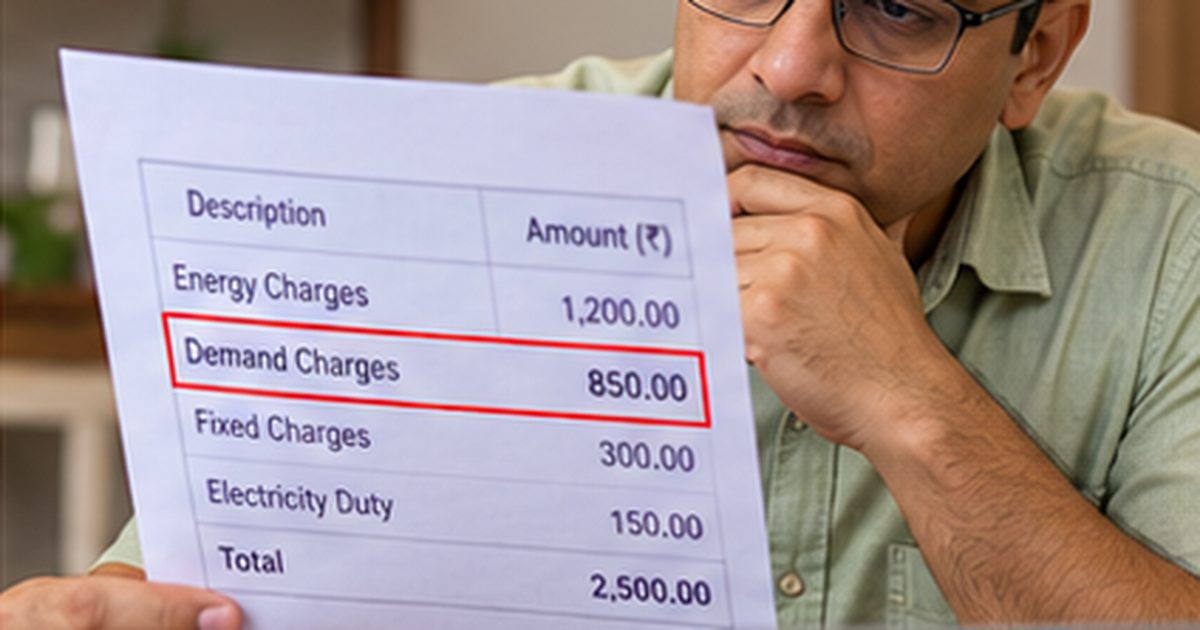
If you are asking what is demand charges in electricity bill, demand charges are tariff charges linked to the power capacity or billed demand of an electricity connection, rather than only the total units consumed. They are common for commercial and industrial consumers, although some domestic tariffs use related fixed or capacity-based charges. The way demand is measured and billed depends on the applicable state tariff.
Your bill may use terms such as sanctioned load, contract demand, maximum demand, billed demand, kW, or kVA. Understanding these labels helps you spot calculation mistakes and identify whether managing peak electricity usage could reduce future costs.
What Is Demand Charges in Electricity Bill?
An energy charge generally reflects how much electricity you consume over a billing period. A demand charge relates to the capacity the electricity system must be prepared to supply, or a tariff-defined quantity of demand. Businesses with heavy equipment can require a high level of power at the same time, even when their total monthly energy use is modest.
The exact charge may be based on contract demand, recorded maximum demand, a minimum billed-demand rule, or another quantity in the tariff order. Maharashtra’s published HT tariff summary illustrates demand rates quoted per kVA per month for particular categories. Never apply those figures to another year or another state without checking the current order.
Why electricity providers collect demand charges
Distribution networks, transformers, and other infrastructure must be able to support customers’ peak electrical needs. The approved tariff can recover some of these capacity-related costs through demand or fixed charges instead of placing every cost into the rate per unit.
This explains why a connection may owe a demand-related charge even in a month when energy use is unusually low. The applicable minimum or billing-demand provision is what matters. For Maharashtra, consult the Maharashtra Electricity Regulatory Commission’s distribution tariff resources and the latest order for your consumer category. A business should review the approved tariff rather than assuming every fee is based on meter units.
Demand charges versus energy charges
Energy is commonly measured in kilowatt-hours, or kWh, and sometimes billed using kVAh under certain tariffs. Power demand is expressed in kW or kVA. Energy tells you how much was used during an interval; demand describes the rate at which power was needed under a defined measurement.
Imagine running a 5 kW load for two hours. The energy consumed would be 10 kWh, assuming the load remained constant. The relevant demand might be 5 kW during that period, but the actual billed demand could follow a different interval and tariff formula. Therefore, two sites using the same number of units can have different demand charges.
What are sanctioned load and contract demand?
Sanctioned load is the capacity the utility approves for a connection under its service rules. Contract demand is a quantity agreed or sanctioned for billing in certain categories, especially larger commercial and industrial supplies. Your tariff documents should explain the units and associated conditions.
The sanctioned figure is not necessarily the same as the actual peak recorded by the meter. A company may use a defined minimum percentage of contract demand or another billing rule, depending on the tariff. Review the signed service details before assuming a meter reading alone sets the billed amount.
What is maximum demand on the bill?
Maximum demand, or MD, reflects the highest average power over an interval specified by the metering and tariff framework. It is not always a split-second spike. Advanced electricity meters can measure interval demand as well as total energy.
The length of the measurement interval and whether the utility bills in kW or kVA matter. If your statement shows MD greater than your expected demand, ask which interval, units, and readings were used. You may need meter records to resolve a discrepancy accurately. A general electricity bill calculator can help estimate usage-related charges but may not model your exact maximum-demand rule.
How are demand charges calculated?
A simplified calculation is Billed demand × demand tariff rate = demand charge, when that is the structure approved for the relevant tariff. The provider must first determine billed demand under its rules. That may not be identical to the highest meter reading if a minimum or contract-demand provision applies.
For a purely hypothetical example, assume a billed demand of 12 kVA and a demand rate of ₹300 per kVA per month. The calculated charge would be 12 × ₹300 = ₹3,600 for that month before considering any special adjustments. These figures are illustrative and not a current rate for any DISCOM.
When a bill covers an unusual period, ask whether the tariff allows proportional adjustment. Additional levies, taxes, penalties, or time-of-day components may be accounted for separately. Do not confuse the final payable total with the demand charge itself.
Are demand charges the same as fixed charges?
They are related but not always identical. Domestic and small-business bills often have a fixed charge based on connected load, service category, or another approved structure. Larger connections may have a specific demand charge based on kVA or kW and tariff-defined billing demand.
Some tariff documents use the combined label Fixed/Demand Charge, while bills may separate them. Look at the exact wording and schedule for your consumer category. Unlike an Additional Security Deposit (ASD), a demand charge is part of the approved tariff. A per-kW fixed charge is not automatically proof that the meter records a monthly demand peak.
Do domestic electricity bills include demand charges?
Some residential tariffs have load-linked fixed charges rather than a separate maximum-demand charge. A household bill therefore may show sanctioned load and fixed charges without an industrial-style demand calculation. Rates and structures differ by state and DISCOM.
Check the tariff label printed on your bill before using an industrial-demand formula. Our guide to calculating electricity bills explains how current-period energy charges fit with fixed charges and other line items.
Why demand charges can increase unexpectedly
A recorded peak may rise when several large electrical appliances or machines operate together. An increase in approved contract demand, a change in tariff category, or a billing-rule adjustment may also affect the billed amount. The reason should be traceable to your meter or authorized tariff details.
For example, a workshop may run several motors at once after installing new equipment. Even if the total monthly operating hours stay similar, the simultaneous peak can be higher. Check whether the company’s billing demand actually follows recorded MD before attributing a higher charge to this behavior.
Can you reduce demand charges?
Where the tariff uses actual peak or maximum demand, shifting some equipment operation away from the same interval may reduce peaks. Staggering motor startups, using appropriate controls, and reviewing electrical load scheduling can sometimes help. The effect depends on your tariff and measured demand.
For safety, electrical-system changes should be designed by a qualified electrician or engineer. Do not modify meter wiring or overload a circuit to avoid a charge. If demand is based mainly on an approved contract quantity, reducing a recorded peak alone might not reduce the bill.
Ask your provider about the process and consequences of applying for a different sanctioned or contract demand if your long-term requirements have changed. Fees, deposit changes, feasibility, and minimum commitment periods may apply.
What happens when actual demand exceeds the approved limit?
Some approved tariffs include excess-demand charges, penalties, or other consequences when measured power exceeds the contracted or sanctioned level. These are not uniform across India. A high maximum-demand figure may also indicate the need to review equipment and connection adequacy.
Read the actual tariff conditions before interpreting an excess-demand line. Ask for the meter record, applied demand threshold, penalty rate, and billing month. Request a safety assessment when repeated overload conditions occur.
How to verify the amount on your bill
- Identify your DISCOM, tariff category, and billing period on the electricity statement.
- Find sanctioned load, contract demand, maximum demand, and billed demand, where displayed.
- Locate the current approved tariff rate for the correct category and period.
- Check the rule that turns meter demand or contract demand into billed demand.
- Multiply the billing quantity by the applicable rate and account for authorized adjustments.
- Compare the result with the demand-charge line and seek a breakdown if it differs.
If the provider uses kVA and you only have a kW figure, do not treat the two as identical. Power factor affects the relationship, and the utility’s metering convention matters. Ask the DISCOM for clarification rather than applying an assumed conversion to an official bill.
When and how to raise a billing complaint
Dispute the charge through your utility’s official portal when the billed demand, applicable rate, or account category seems incorrect. Include the bill, account identifier, tariff reference, meter evidence if available, and your own calculation. Avoid submitting full private records to social-media groups.
Keep the complaint reference and request a written explanation. A mismatch between an online calculator estimate and the bill is a reason to investigate, but not proof of an error, because a general calculator may not include your account’s particular billing-demand rules.
FAQs About Demand Charges in Electricity Bill
Q. Are demand charges based on total electricity units?
A. Not directly. They generally follow a tariff-defined power or capacity quantity, while energy charges relate to measured consumption.
Q. Do I pay demand charges when a factory is closed?
A. Possibly. Some tariffs have a minimum billed-demand or contracted-capacity rule even when consumption is low.
Q. What is the difference between kW and kVA?
A. kW measures real power; kVA measures apparent power. Their relationship depends on power factor.
Q. Can I ask to reduce my sanctioned load?
A. Often there is an application process, but eligibility, technical review, charges, and consequences depend on the utility.
Conclusion
Knowing what is demand charges in electricity bill helps you separate charges for electrical capacity from charges for total energy use. Compare the billed demand, approved tariff, and account category before deciding whether a demand charge is correct.
Disclaimer
This article is general educational information for India and is not an electrical-design or tariff determination service. Demand measurement, rates, penalties, and reduction options depend on state regulations, provider, tariff class, and the circumstances of each connection.